| MANIFESTO |
When it opened on December 1, 1970, Anthology Film Archives issued the following manifesto, which summarized its polemical position: |
|
-- The Essential Cinema: Essays on the films in the collection of Anthology Film Archives, edited by P. Adams Sitney |
AN UPDATE: Our present physical and financial conditions do not permit us to screen the Essential Cinema Repertory as it was initially presented. Our projection is still far from perfect, and 3 programs per day is a far dream. But the Repertory itself is intact and it will remain so, a heroic statement of the art of Cinema. |
-- Jonas Mekas, 1975 |
HISTORY |
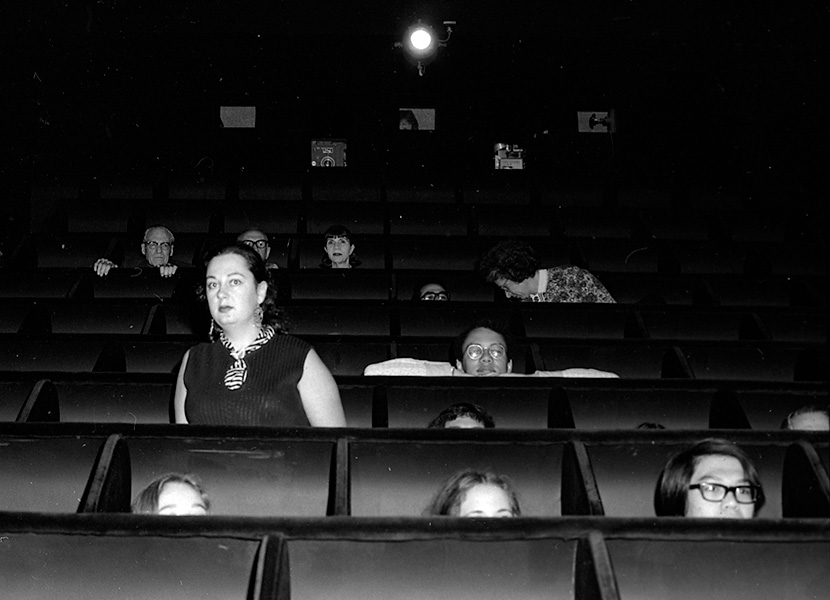
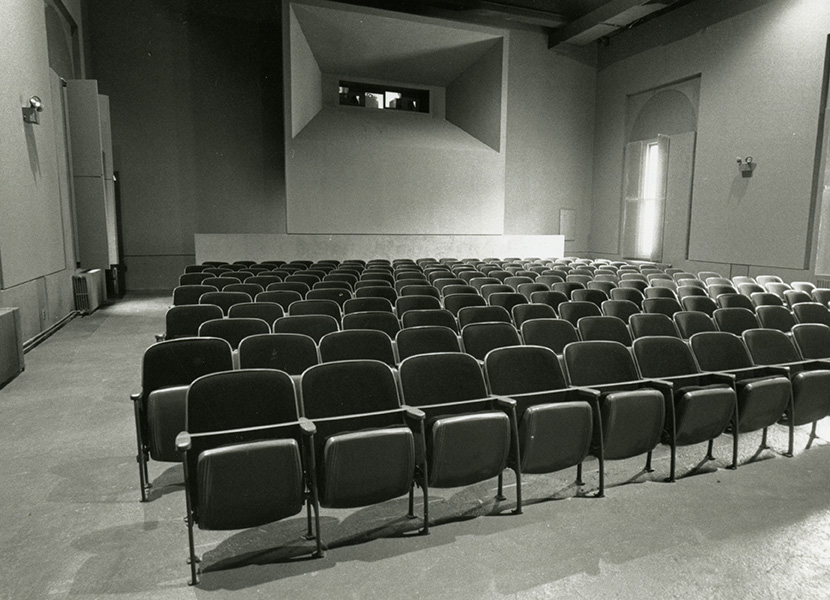
Anthology Film Archives evolved from roots and visions that go back to the early Sixties, when Jonas Mekas, the director of the Film-Makers' Cinematheque, a showcase for avant-garde films, dreamed of establishing a permanent home where the growing number of new independent/avant-garde films could be shown on a regular basis. This dream became a reality in 1969 when Jerome Hill, P. Adams Sitney, Peter Kubelka, Stan Brakhage, and Jonas Mekas drew up plans to create a museum dedicated to the vision of the art of cinema as guided by the avant-garde sensibility. A Film Selection committee -- James Broughton, Ken Kelman, Peter Kubelka, Jonas Mekas and P. Adams Sitney -- was formed to establish a definitive collection of films (The Essential Cinema Repertory) and form the structure of the new institution. Anthology Film Archives opened on November 30, 1970 at Joseph Papp's Public Theater. Jerome Hill was its sponsor. After Jerome Hill's death, in 1974 it relocated to 80 Wooster Street. Pressed by the need for more adequate space, it acquired in 1979 Manhattan's Second Avenue Courthouse building. Under the guidance of the architects Raimund Abraham and Kevin Bone, and at a cost of $1,450,000, the building was adapted to house two motion picture theaters, a reference library, a film preservation department, offices, and a gallery. At the Courthouse, Anthology has found an ideal home as a chamber museum, dedicated to the preservation, study and exhibition of independent and avant-garde film. It is the first museum devoted to film as an art form, committed to the guiding principle that a great film must be seen many times, that the film print must be the best possible, and that the viewing conditions must be optimal. Two motion picture theaters -- the Courthouse Theater (200 seats) and the Maya Deren Theater (66 seats) have been constructed to serve Anthology's film and video exhibition programs. Both theaters have been equipped with 35mm, 16mm, Super-8, 8mm projectors, and video monitors. The Essential Film Repertory is the critical manifesto of Anthology Film Archives, and is presented yearly as a summing up and reminder of the standards of cinema. Anthology maintains that the art of film must be defined in terms of selected works which indicate its essence and its possibilities. In addition to the Essential Cinema Repertory Anthology regularly presents new works and retrospectives of major independent filmmakers, those included in the repertory and those that are not; it premieres independent features, documentary, informational films and videotapes, and provides a platform for a variety of groups working with alternative forms of cinema. During the first fifteen months at the Courthouse there were retrospectives of Hollis Frampton, Ernie Gehr, Marjorie Keller, Robert Breer, Yvonne Rainer, Alexander Hammid, Robert Frank, Maya Deren, Alain Robbe-Grillet, Alexander Kluge, Bruce Elder, Gunvor Nelson, Emile de Antonio, Su Fried rich, Peter Hutton, Warren Sonbert, Francis Lee, Michael Snow, Rudy Burckhardt. During the same period, Anthology provided temporary homes for the Millennium Film Workshop, the Collective for Living Cinema, festivals of Native American Cinema, the Third Lesbian and Gay Experimental Film Festival, and several other independent groups. Although the primary commitment of Anthology is to the avant-garde and independents, it presents national and thematic surveys of commercially or semi-commercially produced films that provide information on contemporary aesthetic movements in the cinema of other countries. An exhibition of the new Soviet documentary cinema was presented in the Spring of 1989, followed by surveys of Philippine, Czech, Dutch and Spanish cinemas (November, 1989, January, March,1990). Andrew Sarris curated an "auteurist" survey, American Narrative Film: Its Roots and Its Flowers 1900-1990, with a focus on the thematic and stylistic contributions of the American narrative film to the art of cinema. In all cases, the emphasis is not on the box office Anthology's Independent Film Preservation program was established in 1972. It has preserved hundreds of essential films produced since 1920. Film shrinkage, color fading, and chemical disintegration are prevented by making protection negatives and master prints. Currently Anthology Film Archives' holdings include more than 4,000 titles. The department's work includes services to filmmakers -- taking care of their original printing materials and supervising the making of new prints. During the last few years, Anthology has been responsible for saving thousands of films -- all independent productions abandoned by film laboratories. Huge collections of filmic documents of life in America during the Fifties, Sixties and Seventies, and many avant-garde film classics would have been lost if they had they not been saved from deterioration or destruction by Anthology's film preservation program. As a supplement to the films included and shown in the Essential Cinema Repertory, Anthology Film Archives has established a film study collection of avantgarde, independent films to serve the film student and film scholar. Unlike the Essential Cinema Repertory where the inclusion of a film is under the strict ruling of the Film Selection Committee, the film study collection is based upon historical principle with the aim of preserving all relevant works. This collection includes early versions of films, unfinished works, rushes, works-in-progress, and other materials. Screenings of these materials are arranged by appointment only. Anthology also arranges screenings for student groups from out of town, provided requests are made in advance. Very soon after Anthology Film Archives opened it began the protection of works by deceased avant-garde filmmakers. At the request of the filmmakers or their estates, collections have been established for Maya Deren, David Brooks, Jerome Hill, Joseph Cornell, Marie Menken, Barbara Rubin, Christopher Maclaine, Ron Rice, Bob Fleischner and others. Finished films are protected and preserved, the unfinished works and outtakes are catalogued and stored. Anthology's reference library contains the world's largest collection of paper materials documenting the history and practice of American and international avant-garde/independent film and video. The holdings include books, periodicals, photographs, posters, tapes of lectures and interviews, distribution and festival catalogs, as well as files on individual film- and video makers and organizations active in independent film and video. The files contain original documents, manuscripts, letters, scripts, notebooks, clippings, photographs and stills. The library is open to the public by appointment. A card catalog provides a detailed index of books and articles in the collection. Materials do not circulate, but a duplicating machine is available. The staff also provides a telephone reference service to long distance users and will send out xeroxes of rare articles and copies of film stills at a minimum charge (provided Anthology has the right to do so). Anthology's publication program was inaugurated in 1970 with Film Culture Reader, edited by P. Adams Sitney. A series of four books, published in cooperation with NYU Press followed: The Cubist Cinema, by Standish Lawder; The Essential Cinema, edited by P. Adams Sitney, which contains a 117 page bibliography of materials in the Anthology Reference Library; The Avant-Garde Film -- A Reader of History and Criticism, edited by P. Adams Sitney; and The Dark of the Screen, by Sidney Peterson. Other publications include Coffee, Brandy and Cigars and A Manhattan Odyssey: A Memoir, by Herman G. Weinberg; A Guide to Independent Film and Video, edited by Hollis Melton; The Independent Film Community, edited by Peter Feinstein; Metaphors on Vision, by Stan Brakhage; Home Made Movies: 20 Years of American 8mm and Super-8 Films, by Jim Hoberman; and The Legend of Maya Deren, Volume I, Parts One and Two, by V¿v¿ Clark, Millicent Hodson and Catrina Neiman; catalogs for the Bruce Elder and the Alain Robbe-Grillet Retrospective; Jim Davis: The Flow of Energy. |
| THE ESSENTIAL CINEMA |
|
Note on Essential Cinema Repertory Collection
In 1968, thanks to the foresight of Jerome Hill, a film-maker and a visionary philanthropist, there arose an occasion to create in New York a film museum dedicated exclusively to film as an art. Lengthy discussions took place to determine the purposes and functions of the new museum. It was decided that one of its main functions would be to serve as a continuous critical tool in the investigation of the essential works created in cinema. Therefore it was decided to create what became known as the Essential Cinema Repertory collection.
|
| COURTHOUSE GALLERY |
The gallery serves as an exhibition space for film- and video makers who are also working as painters, photographers or sculptors -- Harry Smith, Peter Hutton, Paul Sharits, Robert Breer, Michael Snow, Rudy Burckhardt, Marjorie Keller, Carolee Schneemann, Ricky Leacock, and many others. The gallery will also serve as an exhibition space for surveys of film posters and film-related materials. Anthology has over 1,000 rare vintage Hollywood film posters and more than 2,000 posters from the American and international avant-garde film movements. Anthology Film Archives cooperates with archives and museums in the United States and abroad in the preparation of avant-garde film collections and special exhibitions. It has established comprehensive collections of American avant-garde film at the Beaubourg Museum in Paris, the Moderna Museet in Stockholm, and the Oesterreichisches Filmmuseum in Vienna. It has cooperated in preparation of surveys of the American avant-garde film in Canada, Switzerland, Italy, and other countries. It has been working closely with the National Gallery in Washington, D.C. in the preparation of special shows and catalogs. |
|
JOIN US |
|
Become part of a unique museum. Your membership fee will help to strengthen and continue our ongoing programs. |
By supporting Anthology Film Archives you will support a major museum that represents an exciting approach to cinema and provides the polemical discourse vitally needed to refresh the sense of standards necessary to filmmaking and film viewing. |
| BOARD OF DIRECTORS |
|
Jonas Mekas, President
Gail Aronow |
| BOARD OF ADVISORS |
|
Roselee Goldberg Timothy Greenfield-Sanders Ali Hossaini Sara L. Meyerson Ikkan Sanada Ingrid Scheib-Rothbart Joseph Strick Hedda Szmulewicz Honorary Board agnés. b Louise Bourgeois Nam June Paik |
| THEATER RENTAL RATES & INFORMATION |
|
Anthology Film Archives has two theaters which can be rented for both individuals and institutions. Programs presented in the past have included: classes, private screenings, guest lectures, benefits by invitation or open to the public, and multi-day film and video festivals. Rental of the theaters (the MAYA DEREN THEATER seats 75 and the COURTHOUSE THEATER seats 200) includes the services of a projectionist and theater manager. Both theaters are air-conditioned, heated, and equipped to project Super-8mm, 16mm, and 35mm films as well as video. Each theater has its own lobby, which can be used for receptions, information tables, refreshments, etc ... Rates for rental of either theater as of March 2003 are: |
| COURTHOUSE THEATER |
|
| MAYA DEREN THEATER |
|
|
For booking information please contact Anthology Film Archives @ (212) 505-5181x.11 |